
How to stop shanking irons
Quick answer: To stop shanking irons, aim the middle of the face at the ball, keep your grip soft, and stand far enough to avoid crowding the ball. A drill with a headcover or box near the toe helps ensure the clubface hits the ball properly.
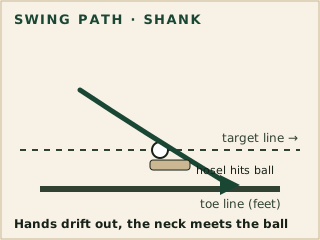
How to stop shanking irons: get the face, not the neck, back to the ball. A shank is the hosel meeting the ball, not a slice that went too far.
12 Strike
The situation
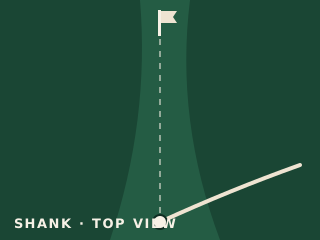
The ball leaves low and sharp to the right, with a click that feels nothing like a groove. You did not curve it. You met it on the hosel, where the shaft meets the head. It shows up on irons, and it loves a tight hold and a body that leans toward the ball.
A check you can do
Look at the club after a bad one. A shank marks the hosel, not the grooves. On the ground, the strike was closer to you than the middle of the face. If the grooves are marked and the ball curved, leave this page and open the slice.
The fix
- 01Aim the middle of the face, and give yourself room Set up so the center of the face is what points at the ball. Stand far enough that you are not crowding it. About a fist-width between the grip end and your thighs is the idea. Setup covers the bend from the hips. If you are falling toward the ball, you are too close.
- 02Soften the hold to a 4 A tight grip can throw the hosel out at the ball. The number and the three-finger hold are on grip pressure. Do not fight a shank by squeezing harder.
- 03Keep the weight centered The shank often appears when you lunge toward the ball on the way down. Feel the trail hip stay back while the chest turns. You are not backing away from the ball. You are refusing to dive at it.
- 04Look at the inside half of the ball That is the half closer to you. Swing so the face covers that spot. Looking at the outside of the ball encourages the neck to get there first.
- 05Shorten the club and the swing until the grooves hit A shorter club, a shorter swing, one groove strike. Then add length back. If it only happens on chips, use a narrow stance, the ball at center, and quiet hands. That is the chip. If the ball is also too far forward, fix ball position in the same session.
A quick shank fix drill
Place a headcover or empty box just outside the ball, about an inch from the toe of the club. Hit half-speed shots without touching it. If you hit the box, your club is moving toward the ball's outside, usually because your weight drifts to the toes. Keep your weight in the middle of your feet and stand a touch further from the ball.
Why shanks come in groups
After one shank, players often tense up and stand closer or reach for the ball, which makes the next one more likely. Stop, hit two or three slow half swings with the drill above, and only then go back to full shots.
Common questions
Why does a tight grip cause shanks?
A tight hold can throw the clubhead out toward the ball, so the hosel arrives first. Try a lighter grip and see if your contact improves.
Can shanks happen with woods?
They can, though shanks are usually talked about with irons and wedges.
How does ball position affect shanks?
It can play a part, so check it, but check your distance from the ball first; standing too close is a common cause.
Is a shank the same as a slice?
No. A slice curves away (to the right for right-handed players). A shank comes off the hosel, not the face, and shoots off sharply to the right.
Related fixes
- Avoiding a tight grip
- Ball position for irons
- Shortening the swing
- Fixing a slice
- Hitting off the toe
Last updated: 2026-10-23
Free tip sheet: First Round Checklist, 10 checks
Get the shank check from this page on one printable PDF, plus the other checks in the First Round Checklist sheet, so you have it at the range. Free by email.
Free printable: Shank Fix Checklist
10 checks on one page to tick off at the range. A PDF, no sign-up needed.
Download the shank fix checklist (PDF)
Want more checks like these? Get the free First Round Checklist tip sheet by email just below.
Part of Fix your miss. See every page in this hub.