
Course Management: Golf Tips for Smarter Decisions
Quick answer: Course management helps beginners score lower by making smart decisions about targets, safe clubs, and avoiding trouble. Aim away from hazards, use your straightest club instead of your longest, know your carry yardages, and usually play to the middle of the green on approach shots to save several strokes.
Course management golf tips help you score lower without a new swing: they are the decisions about where to aim, which club to hit and when to play safe.
18 Strategy
What course management means
In golf, course management means playing the hole with the shots you actually have. It is choosing a target, a club and a shot shape that keep the next shot easy, rather than the one that looks best on a perfect day. (If you came here looking for turfgrass or golf course maintenance careers, this is the playing side of the term.)
Tour players are known for careful strategy, but beginners can gain a lot from it, because their misses are bigger. A beginner who plays to the safe side of every hole can save several strokes a round with the same swing.
The decision table
| Trouble | Aim | Club |
|---|---|---|
| Out of bounds or water on the left | Right half of the fairway or green | Your straightest club, not your longest |
| Out of bounds or water on the right | Left half; if you slice, aim at the left edge | Straightest club; slicers often hit a shorter club straighter |
| Trouble short (water, bunker in front) | Middle to back of the green | One extra club |
| Trouble long (slope, out of bounds behind) | Front-middle of the green | Your normal club, never the extra one |
| Trouble on both sides | Widest part of the landing area | A club that finishes short of where the gap narrows |
| No real trouble | Middle of the target | Normal club, normal swing |
Know your carry yardages
You cannot pick the right club without knowing how far each one carries, meaning how far it flies before it lands, not how far it rolls. At the range, hit ten balls with each of three clubs: a wedge, a 7-iron and your tee club. Ignore the best two and the worst two, and write down where the middle six landed. That is your real carry, and it is often shorter than golfers think. The golf clubs explained page has a beginner distance table as a starting point.
Write your typical miss next to each number, too. A carry yardage is only half the picture; knowing that your driver usually starts right and curves further right tells you where to aim. If you do not know your miss yet, find it from the ball flight first.
Tee shots: target, club and when to lay up
Pick the target first, then the club. Find the trouble, aim away from it, and take the club that keeps your usual miss in play. On short par 4s, a hybrid or iron to the widest part of the fairway often leaves an easier second shot than a driver to a narrow strip. Lay up whenever the driver brings in a hazard that a shorter club does not reach.
Use the scorecard or a course app before the round to note three things on each hole: the length, where the trouble is, and the widest landing area. Then decide on the tee club for each hole in the car park, not on the tee, where nerves and playing partners push you toward the driver. A simple rule: if the fairway at your driver distance is narrower than about 30 paces, or a penalty area crosses it, hit the club that stops short of it.
Tee height and tee side help as well. Tee up on the side of the teeing area nearest the trouble and aim away from it; that opens the widest angle into the fairway.
Approaches: middle of the green
Aim at the middle of the green on almost every approach. A ball in the middle is putting from anywhere, while a ball aimed at a tucked flag and missed by a few yards is in a bunker. Take one extra club over hazards in front; many amateur misses finish short.
Before you choose the club, look at what is past the flag and what is short of it. If missing long is dead (a slope, water or out of bounds behind), play to the front edge and accept a longer putt. If short is dead, play one more club to the middle. When you are between clubs, take the longer one and make a smooth swing: many beginners leave more approach shots short than long.
From more than about 150 yards, or from the rough, a beginner rarely gains anything by aiming at the green at all. Pick the side of the green where a miss leaves an easy chip, and aim there.
Trouble: the one-shot recovery rule
When you are in trouble, give yourself one shot to get back into position. Pick the widest, safest route to the fairway, even sideways. Never try a shot that you would succeed with less than half the time. If the ball is truly unplayable, a one-stroke penalty drop may be cheaper than a second hack.
Know your options before you need them. A ball in a red penalty area can be dropped within two club-lengths of where it last crossed the edge, no nearer the hole, for one stroke (source: R&A Rules of Golf, Rule 17.1d(3)), and an unplayable ball has three relief options, each for one stroke; the golf rules for beginners page explains both. Taking the penalty and dropping in the fairway is often cheaper than two shots trying to escape from the trees.
Short game and putting: leave the easy next shot
Near the green, choose the shot that leaves the easiest next one. Putt when you can, chip when you must carry a little, pitch only when you have to fly the ball (see short game tips). On the green, a long first putt has one job: finish within a club length of the hole. Leaving your putt below the hole gives you an uphill second putt, which is easier to hole.
From just off the green, the order is putt first, then a low chip, and only then a lofted pitch, because the lower the shot, the smaller the miss. On the green, the putting tips for beginners page shows the 3-foot-circle goal for long putts.
Conditions: wind and slopes
Into the wind, take more club and swing smoother; downwind, take less and expect more roll (how to play golf in the wind). On a slope, the ball tends to go where the ground tilts: a ball above your feet tends to go left for a right-handed golfer, a ball below your feet to the right. Aim for that, and grip down for balance.
On a cold or wet day the ball flies shorter, often, so go up one club and keep the swing smooth rather than swinging harder.
Your mind: routine and reset
A pre-shot routine is course management for the head: the same steps before every shot, so a nervous moment does not change your setup. After a bad hole, use the walk to the next tee to reset: name what went wrong in one sentence, decide one thing for the next tee shot, and let the rest go.
A five-point pre-round checklist
- Know your carry for the driver, a hybrid or 5-wood, the 7-iron and the pitching wedge.
- Decide your tee club for every hole that has out of bounds or water in driver range.
- Pick a safe target side for each par 3.
- Choose one swing thought for the day and nothing more.
- Set a budget: how many strokes over bogey you can afford and still reach your goal.
Plan one hole: a worked example
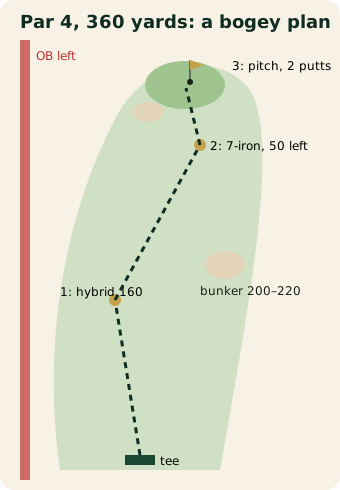
Par 4, 360 yards. Out of bounds runs down the left, a fairway bunker sits on the right at 200 to 220 yards from the tee, and the green has a bunker front-left.
- Tee: your driver carries about 190 yards with a slice. Aim at the left-center of the fairway so the slice comes back to the middle. A hybrid that carries 160 stays short of the bunker; either works, but the hybrid removes the bunker.
- Second shot: about 200 yards left. You cannot reach in one, so hit a 7-iron about 130 yards, leaving about 70, to the right side, away from the front-left bunker.
- Third shot: a pitch to the middle of the green.
- Putts: lag to a club length, tap in. That is a 5, a bogey, with no shot that needed to be special.
The same thinking breaks 100: see how to break 100 in golf.
The same hole when things go wrong
Say the hybrid tee shot does slice into the right rough, about 150 yards out. The green is in range on paper, but the front-left bunker is now directly between you and the flag. The course-management play is a 9-iron or a wedge to the right side of the fairway, about 40 yards short, then a pitch. You still make 5 with two putts, or 6 at worst. The hero shot, a 6-iron over the bunker from the rough, brings in a bunker shot and a likely 7.
A par 3 example
Par 3, 140 yards, water short and right, a big slope behind. Your 7-iron carries 135, your 6-iron 145. Take the 6-iron and aim at the left-middle of the green: it covers the water if you catch it a little thin, and the slope behind only matters if you hit your best shot, which still leaves a chip. Three on the card is a bonus; four is the plan.
Writing these plans takes two minutes per hole the night before. Over a round, the strokes you save come mostly from the double bogeys you never make.
Free tip sheet: First Round Checklist, 10 checks
A one-page printable PDF with the 10 checks for common first-round trouble. Free by email.