
Putting Tips for Beginners: Make More, 3-Putt Less
Quick answer: Focus on speed control first, use a simple setup with eyes over the ball, a light grip, and a shoulder-rock stroke. Practice drills like the 3-zone and ladder to build consistency, and read greens by looking from the low side and aiming high on breaking putts.
Putting tips for beginners start with speed, not line: many three-putts come from a first putt that finishes too far from the hole.
15 Green
Setup: a simple checklist
- Eyes: over the ball or just inside the line, never outside it toward your toes.
- Grip: light, about a 4 out of 10, palms facing each other. Any join works; many golfers use a reverse overlap, with the lead forefinger over the trail fingers.
- Posture: bend from the hips, arms hanging, elbows soft. You should be able to rock the shoulders without the body swaying.
- Ball position: just forward of center, so the putter meets it at the bottom of the stroke or slightly on the way up.
- Alignment: aim the face first at the start line, then set your feet and shoulders parallel to it, the same order as the golf stance.
A check you can do
From a few steps, roll a ball with your hand toward a hole or a coin. Notice the pace that dies near the target. Then hold the putter and send a ball at that same pace. If the putter ball is much faster or much slower than the hand-rolled one, the stroke is adding speed you did not choose.
The stroke: rock the shoulders, quiet the wrists
A good putting stroke is a pendulum from the shoulders. The arms and putter move as one piece, the wrists stay quiet, and the putter head stays low to the ground. Make the backstroke and through-stroke about the same length, and let the length of the stroke, not a hit at the ball, set the distance. A common beginner fault is a short backstroke followed by a jab; the result is a ball that comes off at a different speed every time.
Speed control
Speed matters more than line because a putt with the right pace and a slightly wrong line finishes close, while a putt on a perfect line with the wrong pace finishes four feet past or short. The full explanation is on putting speed control; these two drills build it.
The 3-zone drill
Put tees at 10, 20 and 30 feet. Putt three balls to each distance, trying to stop every ball within a club length past the tee. Then putt one ball to each in random order. Count how many finish in the zone out of twelve and try to beat it next time.
The ladder drill
From one spot, putt the first ball about 10 feet, then try to finish each next ball a little past the one before, without touching it. Five balls make a ladder. If one comes up short of the previous ball, start again.
Reading greens: the basics
Read the slope from the low side of the putt, where it is easier to see. Water drains off a green, so look for the low edge and expect the ball to fall that way. Uphill putts need a firmer stroke and break less; downhill putts need a gentle one and break more. For beginners, a simple rule helps: on any breaking putt, play more break than you think and aim at a spot on the high side, then hit the putt to that spot at the right pace.
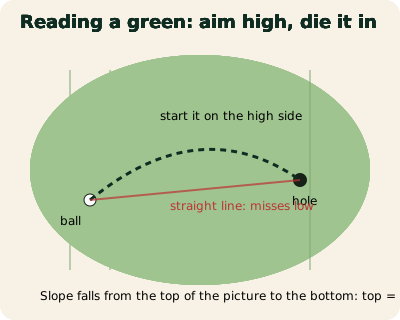
Low side, high side
When the green tilts across your line, the ball curves toward the low side. Many beginners under-read the curve, so they miss below the hole, on the low side, where the ball never had a chance. If you miss, miss on the high side: a ball above the hole can still fall in, and the next putt is often shorter.
Uphill and downhill
Walk halfway along the putt and look from the side. If you are standing lower than the ball, the putt is uphill: hit it firmer, and it will curve less. If you are higher, it is downhill: the ball will keep rolling and curve more, so pick a spot short of the hole and roll it to that spot. Your feet often feel slope better than your eyes, so notice which way your weight leans as you walk.
A 20-second read
- As you walk onto the green, look at the whole green for its lowest corner or the way water would run off.
- Look from behind the ball to choose the high side.
- Pick a start line: a spot on the high side of the hole, then a mark a foot in front of the ball on that line.
- Decide the speed, and commit. A good speed with a slightly wrong line still finishes close.
Short putts: a 3-foot routine
Pick a spot on the grass a few inches in front of the ball on your line, set the face square to it, take one look at the hole and stroke the ball over the spot. Keep your head still until you hear the ball drop. Practise ten three-foot putts in a row before you leave the practice green; it builds the trust you need on the course.
Pick a firm pace on short putts, enough to finish about a foot past the hole, so small bumps and slopes near the cup affect the ball less.
Lag putting: the 3-foot circle
From 30 feet and beyond, picture a circle about three feet around the hole and try to stop the ball inside it. You are no longer trying to hole long putts, only to leave a tap-in. This one change can remove many three-putts.
Three-putts are a common leak on the way to breaking 100: two a round becomes four or five on a nervous day. From the fringe or just off the green, a putt is usually a safer first choice than a chip, because a poor putt still finishes nearer than a poor chip.
A 20-minute practice session
| Minutes | Drill | Goal |
|---|---|---|
| 0–5 | Hand roll, then putter, to a coin from 10 feet | Match the pace |
| 5–12 | 3-zone drill (10, 20, 30 feet) | 8 of 12 in the zone |
| 12–16 | Lag putts from 40 feet to the 3-foot circle | No ball outside the circle |
| 16–20 | 3-foot putts around the hole | 10 in a row |
Ten minutes on the practice green before a round
Before you play, skip the 3-footers at first. Roll five long putts across the green to different edges, without a hole, just to learn the speed for the day; greens change with the weather, mowing and time of year. Then hit five putts from 30 feet to a hole and see how many finish inside the 3-foot circle. Finish with ten putts from 3 feet, all with your full routine, so the last thing you see before the first tee is the ball going in. If the practice green is crowded, the speed part matters most; do that and leave the rest.
During the round, notice the speed of the first two greens and adjust. The practice green is not always the same speed as the course greens, so the first few holes are where your feel is set.
Common putting mistakes and fixes
- Decelerating: a long backstroke that slows into the ball. Shorten the backstroke and make the through-stroke at least as long.
- Looking up early: the shoulders open and the ball goes left. Listen for the ball instead of watching it.
- Wristy stroke: the face flips. Try a lighter grip and feel the shoulders rock.
- Never reaching the hole: aim to finish putts about a foot past on short and medium putts.
- Too much attention to line on long putts: judge speed first, line second.
- Ball too far back or forward: the face is open or closed at contact. Put the ball just forward of center, under your lead eye, and check it with a ball dropped from the bridge of your nose.
- Aiming the body, not the putter: set the putter face first, square to your start line, then build your stance around it.
- Grip too tight: tension kills feel for distance. Hold it about a 4 out of 10 and keep that pressure through the stroke.
- Rushing the short ones: the 3-foot putt gets the same routine as the 30-foot one: one look, set, stroke.
- Practising only short putts: long putts set up the score. Spend at least half of every practice session on putts over 20 feet.
Putting is a quick way to save strokes when you are trying to break 100, and it fits into good course management: leave the easy next putt.
Work on one mistake at a time. Pick the one that cost you the most putts in your last round: count your three-putts and note whether the first putt was too long, too short, or off line. Short and long means a speed problem, and the drills above come first. Off line from short range usually means the face, not the read.
Common questions
Why is speed more important than line on short putts?
Speed controls how close the ball finishes to the hole. A slightly wrong line with the right pace still finishes near the hole, while a perfect line with the wrong pace can leave the ball far away.
How do I read the slope of a green?
Look from the low side of the putt, where the slope is easiest to see. Water drains off a green, so the low edge shows the direction the ball will roll.
What is the 3-foot routine?
Pick a spot on the grass a few inches in front of the ball on your line, set the face square to it, take one look at the hole, and stroke the ball over the spot. Keep your head still until you hear the ball drop.
Why should I aim on the high side of a breaking putt?
A ball above the hole can still fall in, and the next putt is often shorter. Missing on the low side means the ball never had a chance to reach the hole.
Related fixes
Last updated: 2026-10-23
Free tip sheet: First Round Checklist, 10 checks
Get the putting speed check from this page on one printable PDF, plus the other checks in the First Round Checklist sheet, so you have it at the range. Free by email.
Part of Short game. See every page in this hub.