
Golf swing tips, in the order that matters
Quick answer: Focus on a sound grip, balanced setup, turning back with the chest, shifting weight to the lead foot, and finishing balanced on the lead foot. Practice half swings until the finish holds, and keep rhythm simple with a "one" on the backswing and "two" through.
These golf swing tips go in one order: grip, setup, turn back, shift, turn through and finish. Fix the first one that fails and leave the rest alone.
12 Strike
The situation
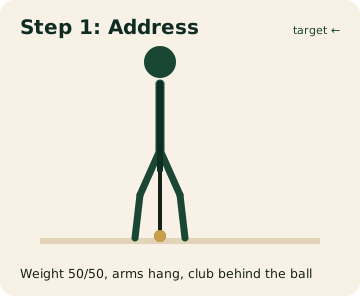
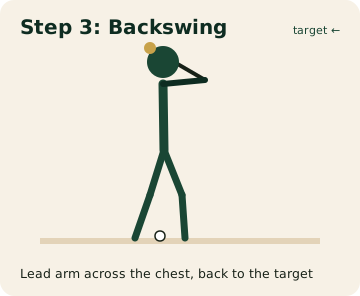
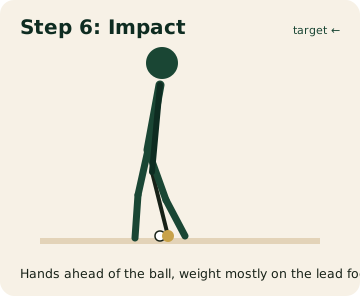
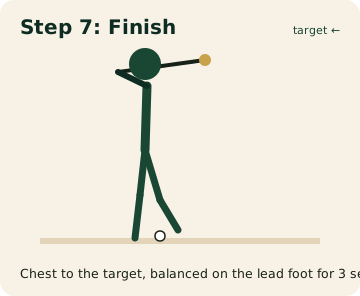
Four key positions; all seven are on the golf swing sequence.
You are carrying a list of swing tips and the ball goes everywhere. That is normal. The basics are few: a sound grip, a balanced setup, a turn away, a turn through, and a finish on the lead foot. Most faults on this card come from one of those going missing.
A check you can do
Make five half swings and hold the finish each time. Can you stand there, balanced on the lead foot with the chest facing the target, until the ball lands? If you fall back or step off, balance is the first thing to fix, before any other swing thought.
The fix
- 01Start from the grip and the setup The hands and the aim come first. Check the grip and setup and aim before you change the swing.
- 02Turn back with the chest The chest turns away from the target and the arms swing up with it. The trail knee keeps a little flex.
- 03Shift, then turn through From the top, the weight moves to the lead foot first, then the body turns through the ball.
- 04Finish balanced End with the weight on the lead foot, the chest at the target, and the trail heel up. Hold it until the ball lands.
- 05Half swings before full swings Hit balls at half speed until the finish holds. The rhythm is on swing tempo.
Golf swing basics, in order
The golf swing looks complicated because it happens fast. Slow it down and it is a short chain of simple parts, and each one depends on the part before it.
- Grip. The hands decide where the face points. Start at how to grip a golf club.
- Stance and aim. Feet about shoulder width for a mid iron, knees flexed, a slight tilt from the hips, and the face aimed at the target before the body. See the golf stance and ball position.
- Turn back. The chest turns away from the target and the arms swing up with it. The trail knee keeps its flex so you turn rather than sway.
- Shift and turn through. From the top, the weight moves to the lead foot first, then the hips and chest unwind, and the arms and club follow.
- Finish. Weight on the lead foot, chest at the target, trail heel up, held until the ball lands.
Rhythm matters more than speed
Many beginners do not swing too slowly; they start down too fast. A rushed start from the top throws the club outside the line and is one of the commonest causes of a slice and a topped shot. A simple count, "one" on the way back and "two" through, keeps the order right. The full drill is on golf swing tempo, and every step in order is on the golf swing sequence.
Golf swing tips for beginners
Start with the grip and the setup, not the swing. Many beginner misses start before the club moves.
- Grip first. Lay the handle across the base of your fingers, not your palm. Check it on the grip page.
- Set up the same way every time. Use the same posture and ball position for the club you're holding. See setup and ball position.
- Turn back, then turn through. Your shoulders turn away; your weight shifts to the lead side; you turn through to a balanced finish. The order is on swing sequence.
- Swing at a speed you can hold your finish at. Balance first, speed later (tempo).
- Fix one thing per session. Pick the first step that fails and practise just that with the beginner swing drills.
If the ball keeps curving, go to fix your miss and find the miss you actually have.
Iron swing tips
With irons you hit the ball first, then the turf. The divot, if you take one, starts after the ball.
- Ball position. Short irons go near the center of your stance. A mid-iron goes near the center, or up to about one ball-width forward. More on irons.
- Hit down a little and let the loft lift the ball. Don't try to scoop it up; scooping is how you get the thin shot.
- Same swing, same speed, for every iron. The club's length and loft change the distance; you don't need to swing harder with a longer iron.
- Check your strike. Hitting the ground first? See the fat shot.
- Struggling with long irons? A hybrid can replace a long iron. See hybrids and woods.
Driver swing tips
The driver is the club you hit slightly on the way up, off a tee, so the setup changes a little.
- Ball opposite your lead heel. See ball position.
- Tee it so about half the ball sits above the top line of the face.
- Widen your stance a little compared with your irons.
- Swing at about 80% effort. Smooth beats hard. A balanced finish is the check.
- A low tee will not cure a slice. Find the cause on the slice page. If the driver keeps going wrong, try the same swing with a hybrid first. More on driving.
Swing tips for seniors and women
The swing is the same game for everyone. What usually changes is the equipment, not the swing.
- Check your clubs fit you: length, weight and shaft flex. Fit them to your swing speed, not your age or gender: slower swings usually launch the ball better with more loft and a softer flex. A fitter can measure your speed. See golf tips for women beginners and beginner clubs.
- Grip size and grip style matter. Larger, softer grips, or the ten-finger baseball grip, can be more comfortable for some golfers with sore or arthritic hands.
- Warm up before you swing hard. Use the warm-up routine.
- Choose tees that fit your distance, so the course plays the way it's meant to.
If a stiff or sore body limits your turn, ask a PGA professional or your doctor rather than forcing it. Lessons covers how to choose a coach.
Golf swing analysis at home (phone video checks)
Golf swing analysis at home doesn't need special gear. A phone and two camera angles are enough to check the basics.
- Film from two angles: face-on (camera facing your chest) and from behind, looking down your target line.
- Set the phone at the height of your hands at address, far enough back to see the whole club at the top.
- Check one thing per video. Pick from the order on this page: grip, setup, turn back, shift, turn through and finish.
- Compare with the check on the matching page. For example, ball position from face-on (ball position), or the turn from behind (backswing).
- Show it to a coach. Video helps a coach see what happened (lessons).
For indoor checks without a ball, see practice at home.
How to practise the swing
Work on one part at a time, at half speed, with a mid iron. Half swings, from hip height to hip height, teach the strike and the turn without the long backswing that causes many mistakes. When ten half swings in a row finish balanced, lengthen the swing. If you want structured drills, beginner golf swing drills has a set to work through in order.
When a shot goes wrong, look at the ball flight before you change the swing. The Fix your miss pages turn each bad shot into a single check, which is faster than guessing which part of the chain broke.
Common questions
What is one common swing mistake to check?
Starting down too fast is one thing to check. A slow, controlled start from the top can help.
How can I improve my swing tempo?
Use a simple count: "one" on the way back and "two" through. This can help you keep a steady rhythm.
Why is balance important in the golf swing?
Staying balanced can help you turn and finish with control.
What is the best way to practice the golf swing?
Practice with half swings using a mid iron. Focus on turning back, shifting weight, and finishing balanced. This helps you practise a repeatable motion.
Related fixes
Last updated: 2026-10-23
Free tip sheet: First Round Checklist, 10 checks
A one-page printable PDF with the 10 checks for common first-round trouble. Free by email.