
The Golf Swing Sequence, Step by Step
Quick answer: The correct golf swing sequence for beginners is address, takeaway, backswing, transition, downswing, impact, and finish. Learn these seven steps in order, one per range session. Each step features a simple diagram, one checkpoint, and one drill to help you master the order and build a smooth, consistent golf swing.
The golf swing sequence is the order your body moves in: set up, take the club away, turn to the top, then unwind lower body first, then the torso, the arms and finally the club.
12 Strike
The 7 steps at a glance
This page is the step-by-step part of the golf swing basics hub. Each step below has a simple face-on diagram for a right-handed golfer, one checkpoint and one drill. Learn them in order, one per range session, rather than all at once.
| Step | What moves | Checkpoint |
|---|---|---|
| 1. Address | Nothing yet: grip, stance, aim, ball position | Face aimed first, feet parallel to the target line |
| 2. Takeaway | Shoulders, arms and club together | Club shaft parallel to the ground, toe roughly pointing up |
| 3. Backswing | Chest turns, lead arm swings across, wrists hinge | Back to the target, weight into the trail heel and instep |
| 4. Transition | Lower body starts down while the club finishes going back | Pressure moves toward the lead foot before the arms pull |
| 5. Downswing | Hips, then chest, then arms, then club | Hands drop in front of the trail thigh |
| 6. Impact | Body still turning, club catching up | Weight mostly on the lead foot, hands level with or just ahead of the ball |
| 7. Finish | Everything has turned through | Chest at the target, trail heel up, balanced for 3 seconds |
Step 1: Address
The sequence starts before the club moves. Grip the club with two knuckles of the lead hand showing (how to grip a golf club), aim the clubface at the target, then set your feet, hips and shoulders parallel to that line (golf stance and setup). Ball position changes with the club: center for a short iron, a little forward for a mid iron, opposite the lead heel for a driver (ball position). A sequence cannot fix an address that is aimed somewhere else.
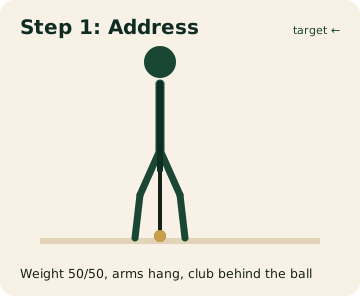
Drill: the clubface check. Set up, then lay a second club on the ground along your toes and step back behind the ball. If that club points right of the target (for a right-handed golfer), your body is aimed right and the swing will fight it. Do this for the first five balls of every range session.
Step 2: Takeaway
The first two feet of the swing set the pattern. Move the club, hands, arms and chest away together, as one piece, low and slow. When the shaft is parallel to the ground, the clubhead should be outside your hands and the toe pointing roughly at the sky. A takeaway that is snatched inside with the hands alone tends to lead to a loop at the top and a swing that comes over the ball.
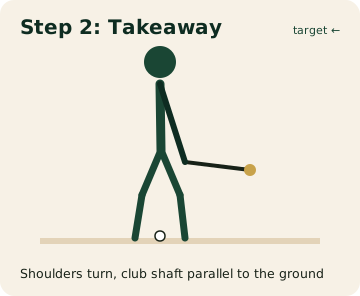
Drill: the tee-in-the-grip takeaway. Push a tee into the hole at the end of your grip. Swing back until the shaft is parallel to the ground and stop. The tee should point roughly at the ball-to-target line, and the clubhead should still be outside your hands. Ten slow reps, then hit five balls at half speed.
Step 3: Backswing
Keep turning the chest until your back faces the target, as far as it comfortably goes. The wrists hinge so the club points up. The trail knee keeps some of its flex, and you feel pressure building into the trail heel and the inside of the trail foot, not the outside edge. For most beginners a three-quarter backswing is plenty: a longer swing that you cannot control adds little.
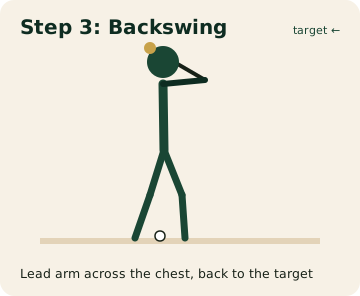
Drill: back to the target. Without a club, cross your arms on your chest and turn until your back faces the target while your head stays roughly over the ball. Feel the pressure in your trail heel. Then make the same turn with a club and hold the top for a two-count before swinging.
Step 4: Transition
The transition is the change of direction, and it is where many sequences go wrong. Good players start the downswing from the ground up: as the club is still finishing its backswing, the pressure shifts toward the lead foot and the lead hip begins to open. If the shoulders and arms start first, the club is thrown out and over the line. That is the classic over-the-top move.
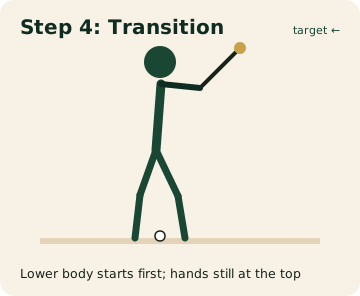
Drill: the pause at the top. Swing to the top, pause for one second, then start down by shifting pressure into your lead foot before your arms move. Hit five balls with a 7-iron at 60 percent speed. The pause makes it hard to start with the hands. Pair it with golf swing tempo counting.
Step 5: Downswing, lower body first
The order down is hips, then chest, then arms, then club. Each part speeds up and then hands its speed to the next, which is why a smooth swing can still be fast at the bottom. The feel many golfers use is "bump and turn": a small bump of the hips toward the target, then turn. The hands should drop toward the trail thigh before they start to swing out to the ball.
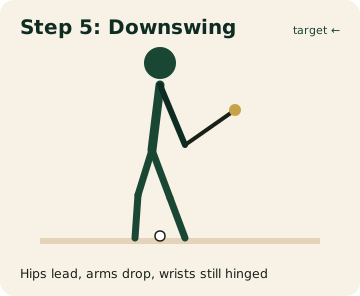
Drill: the step drill. Start with your feet together, swing back, and step toward the target with the lead foot as the club reaches the top, then swing through. Stepping first forces the lower body to lead. Use a short iron and a low tee.
Step 6: Impact
At impact, most of your weight is on the lead foot, the hips are open to the target, the chest is roughly square to slightly open, and the hands are level with or just ahead of the ball with an iron. The club meets the ball, then the turf. You do not create this position by trying to hit it; it is the result of the first five steps in order.
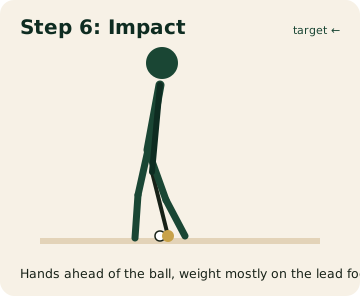
Drill: the towel line. Lay a towel flat about four inches behind the ball. Hit balls without touching the towel. If you clip it, your low point is behind the ball, which usually means the weight stayed back. See how to stop hitting it fat.
Step 7: Follow-through and finish
Keep turning until your chest faces the target, your trail heel is up with only the toe on the ground, and the club is over your lead shoulder. Hold it for three seconds. If you cannot hold the finish, something earlier was out of order, usually the transition. A held finish is the simplest checkpoint you have, because you can see it without a camera.
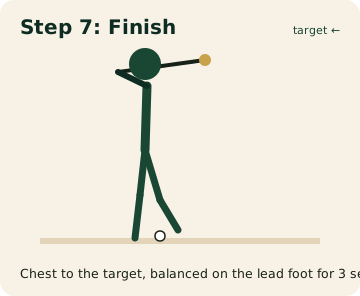
Drill: the three-second finish. After every shot in your next bucket, hold the finish and count to three before you look at the ball flight. If you wobble, the next ball is a half-swing until you can hold it again.
Sequence mistakes and the miss they cause
- Arms and shoulders start down first (over the top). The club cuts across the ball from outside to in. Usual miss: a slice, or a pull if the face is closed.
- Weight stays on the trail foot. The low point of the swing moves behind the ball. Usual miss: fat or thin shots.
- Early release (casting). The wrists unhinge at the top, so the clubhead arrives early and high. Usual miss: fat, thin or topped shots and weak, high iron shots.
- Body stops turning, hands flip. The face closes fast through impact. Usual miss: a hook.
3 drills to feel the right order
- Step drill. Address the ball with your feet together. As you swing back, step the lead foot toward the target, then swing down. The step forces the lower body to start the downswing. Hit ten half-speed shots.
- Pump drill. Swing to the top, pump halfway down while you feel the weight shift to the lead foot, go back to the top, then swing through. It slows the transition so you can feel the order.
- Feet-together drill. Hit short irons with your feet almost touching. You cannot sway or throw your body at the ball without falling over, so the arms and body must stay in sequence. Balance at the finish is the score.
Pair any of these with the count on golf swing tempo, and see beginner golf swing drills for more.
Driver vs iron: what changes
The order is the same for every club. What changes is the set-up and the bottom of the swing. With an iron, the ball is further back and the club strikes it on the way down, taking a divot after the ball. With the driver, the ball is teed up opposite the lead heel, your stance is wider, your spine tilts slightly away from the target, and the club meets the ball just after the bottom of the arc, on a slight upswing. If the driver goes wrong, check the set-up before you change the sequence; the driver page covers it.
How to practise the sequence in a week
Session one: steps 1 and 2 only, hitting half shots with a 9-iron. Session two: add steps 3 and 4 with the pause drill. Session three: the step drill and the towel line for steps 5 and 6. Session four: full swings, holding every finish for three seconds. Film one swing from face-on at the start and end of the week with your phone and compare it to the diagrams above: the positions will not match exactly, and they do not need to, but the order should.
If one step keeps breaking down, stay on it. A sound address and takeaway often fix more beginner swings than a downswing thought, because many downswing faults start with a setup or backswing that left the body nowhere good to go.
Common questions
What happens if the arms start the downswing before the lower body?
If the arms start the downswing before the lower body, the club tends to come over the top, leading to a slice or pull. This is a common mistake that disrupts the sequence and affects ball flight.
Why is the lower body leading the downswing important?
The lower body leading the downswing helps the club follow the correct path and maintains the proper angle of attack. This helps the club strike the ball on the correct part of the swing arc, improving accuracy and distance.
How does the sequence affect the ball's starting direction?
The ball's starting direction is mostly determined by the clubface angle at impact. A correct sequence helps the face arrive square, leading to a more accurate shot.
Can a poor sequence cause fat or thin shots?
Yes, a poor sequence can lead to fat or thin shots if the weight stays on the trail foot or the low point of the swing moves behind the ball. This is often due to an incorrect transition or downswing order.
Related fixes
Last updated: 2026-10-21
Free tip sheet: First Round Checklist, 10 checks
A one-page printable PDF with the 10 checks for common first-round trouble. Free by email.
Part of Swing. See every page in this hub.