
How to stop hooking the golf ball
Quick answer: To stop hooking the golf ball, check your grip and swing path. A strong grip with an in-to-out path can close the face to the path, which produces a hook. Adjust your grip to show two knuckles on the lead hand and check that your swing path is not moving too far from inside to outside.
How to stop hooking the golf ball: square the face to the path. The ball curves hard left because the face is closed to the path the club is traveling, and swinging easier will not open it.
11 Ball flight
The situation
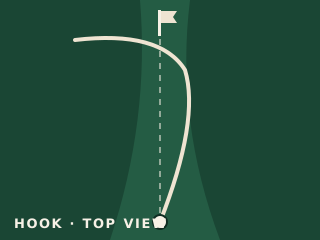
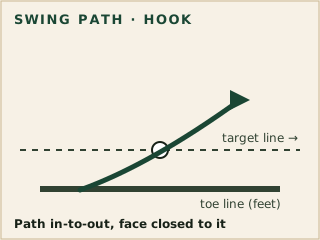
For a right-handed player, a hook bends to the left. It can start right of the target and then dive left. Sometimes it starts at the target and keeps turning. Both are the face closed relative to the path, with a path that can swing from inside the toe line out to the right.
If the ball starts left and flies straight left with no curve, that is a pull, not a hook. Check aim first.
A check you can do
Take your grip and look down without moving the hands. Count the lead-hand knuckles. Three or four is a strong hold, and it closes the face. Then put one club on the ground along your toes, pointing at the target, and make a slow swing. If the clubhead comes from well inside that line and swings out to the right after the ball, the path is in-to-out. A strong grip plus an in-to-out path can add up to a hook.
The fix
- 01Turn the lead hand back toward two knuckles Open the lead hand, turn it a little toward the target, and close it again until you see two knuckles, not three or four. A strong hand tends to shut the face. Do not overshoot into a weak grip.
- 02Check aim before you blame the swing If the feet and shoulders point right of the target, the swing follows them out to the right and the face closes to save the shot. Set the face at a mark first, then the feet parallel, as on setup and aim.
- 03Move an iron ball forward if it has crept back A ball too far back meets the club while it is still swinging out to the right, and the face shuts over it. Mid-iron position is center, or up to about one ball-width forward, on ball position.
- 04Keep the body turning through the ball When the hips and chest stop turning, the hands flip and the face closes. Keep turning until the chest faces the target at the finish, with the weight on the lead foot.
- 05Ten balls at half speed The win is a ball that starts nearer the target and curves less, not a longer ball. If it now starts left and stays left, that is a pull. Check aim again before you touch the grip again.
Hook vs draw
A draw curves gently left and finishes on target; a hook curves hard and keeps going. Same cause, more face closure.
Hooks with the driver
A driver hook can come from a ball too far back or a strong grip; check both before you change the swing.
Common questions
What causes a hook?
A hook is caused by a closed clubface relative to the swing path, which can come from a strong grip, improper aim, or a ball position that is too far back.
Can a weak grip cause a hook?
It's unlikely; a weak grip tends to leave the face open, which leads toward a slice. A strong grip can contribute to a hook by closing the face too much at impact.
How does ball position affect a hook?
A ball that is too far back in the stance can cause the club to strike the ball while still swinging out to the right, leading to a closed face and a hook.
Does a hook happen more with irons or drivers?
A hook can happen with any club. With drivers, a hook can come from a strong grip or incorrect ball position.
Related fixes
Last updated: 2026-10-21
Free tip sheet: First Round Checklist, 10 checks
Get the hook check from this page on one printable PDF, plus the other checks in the First Round Checklist sheet, so you have it at the range. Free by email.
Free printable: Hook Fix Checklist
9 checks on one page to tick off at the range. A PDF, no sign-up needed.
Download the hook fix checklist (PDF)
Want the drills in a day-by-day order? Fix Your Hook is a 14-day printable plan ($14.99 USD). The checklist and the tips stay free.
Part of Fix your miss. See every page in this hub.