
The Golf Downswing Sequence for Beginners
Quick answer: A slice is usually caused by starting the downswing with the shoulders and arms. To fix it, shift pressure to the lead foot first, let the hands drop, and feel the club approach the ball from inside. You can also place a headcover just outside and behind the ball and miss it on your way down.
The golf downswing sequence starts from the ground up: pressure shifts to the lead foot, the hips turn, and the arms and club follow.
12 Strike
The order: lower body, torso, arms, club
In a good downswing, each part of the body starts and speeds up in turn: first the lower body, then the torso, then the arms, and finally the club. Each part hands its speed on to the next, a little like cracking a whip. That is why a swing that feels smooth can still produce plenty of clubhead speed. When the order is mixed up, usually because the arms and shoulders start first, the club comes down on the wrong path and arrives at the wrong time. This page covers the second half of the golf swing sequence; the first half is the golf backswing.
Transition: the first move down
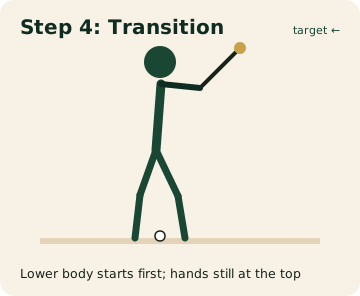
The transition is the change of direction at the top, and it decides the rest of the swing. The first move down is a small shift of pressure into the lead foot, often starting just before the club has finished going back. The lead hip then begins to open. The hands and arms stay passive for a moment, simply falling as the body starts. If your first feeling at the top is to hit with the hands or turn the shoulders hard, the club will be thrown outward.
Hand path and shaft lean
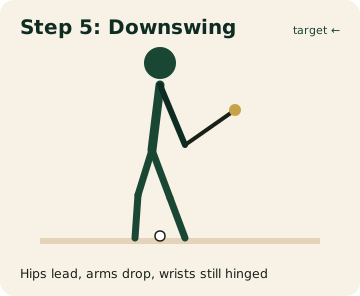
As the body turns, the hands drop down in front of the trail thigh, keeping the wrists hinged. From face-on, the hands should be roughly opposite the trail thigh when the shaft is parallel to the ground on the way down. Keeping the hinge until late lets the club release its speed at the ball, not before it. With an iron, the shaft leans slightly toward the target at impact, with the hands level with or just ahead of the ball.
Impact positions
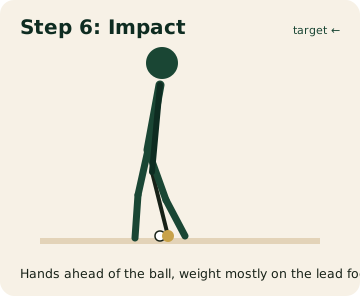
At impact, most of the weight is on the lead foot, the hips are open to the target, the chest is roughly square or a little open, and the head is behind the ball. With an iron, the club meets the ball and then the turf, taking a divot after the ball. You do not make this position by trying to hit it; it is the result of a good transition and downswing.
Over the top (slice) and how to fix it
Over the top means the club comes down outside the line it went back on and cuts across the ball from outside to in. It is usually caused by starting the downswing with the shoulders and arms. The ball starts left and slices right, or is pulled left. To fix it, start down with the pressure shift to the lead foot, let the hands drop first, and feel the club approach the ball from inside. Put a headcover just outside and behind the ball and miss it on the way down. The full fix is on how to fix a slice.
Early release (fat, thin, topped)
Early release, sometimes called casting, is when the wrists unhinge at the start of the downswing instead of near the ball. The clubhead reaches the bottom of its arc too early, behind the ball. The result is fat shots, thin shots, or topped shots as the club rises again. It often comes from trying to help the ball into the air or from hanging back on the trail foot. The fix is the pressure shift first, the hands leading, and trusting the loft of the club.
3 downswing drills
- Step drill: start with your feet together. As the club reaches the top, step toward the target with the lead foot, then swing through. The step forces the lower body to lead. Hit ten balls with a short iron at half speed.
- Pump drill: swing to the top, pump halfway down while feeling the pressure move to the lead foot and the hands drop, return to the top, then swing through. It slows the transition so you can feel the order.
- Pause at the top: swing to the top, pause for a full second, then start down from the ground up. Without momentum, it is very hard to start with the hands.
What it should feel like
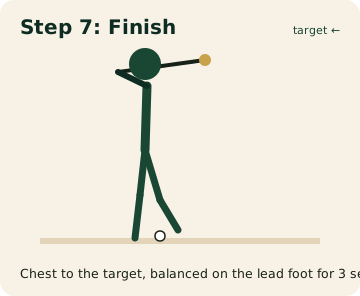
A good downswing feels less like hitting and more like turning through the ball. Many golfers describe a feeling of "bump and turn": a small bump of the hips toward the target, then a turn. The arms feel as if they are along for the ride. You finish balanced on the lead foot, with the chest facing the target and the trail heel up. If you can hold that finish for three seconds, the order was probably right. If the swing feels rushed, slow the whole thing down with golf swing tempo.
How the downswing changes from wedges to driver
The order is the same for every club. What changes is the strike. With irons and wedges, the club is still travelling slightly down at impact, so it meets the ball and then the turf. With a fairway wood, the club sweeps the ball off the grass at the bottom of the arc. With the driver, the ball is teed forward and the club meets it just after the bottom of the arc, on a slight upswing. If your driver is going wrong, check your setup before you change the downswing; see how to hit a driver straight.
A one-week downswing practice plan
| Session | Focus | Drill |
|---|---|---|
| 1 | Transition | Pause at the top, 20 balls with a 7-iron at half speed |
| 2 | Lower body first | Step drill, 20 balls with a short iron |
| 3 | Hand path | Pump drill, then headcover just outside the ball |
| 4 | Putting it together | Full swings at 80 percent, holding every finish |
Film one swing from face-on at the start and end of the week and compare the transition. You are looking for the hips starting before the arms, not for a perfect position.
Common questions
What causes a slice during the downswing?
A slice is usually caused by the club coming down outside the intended path, often due to starting the downswing with the arms and shoulders instead of the lower body.
How can I ensure the club hits the ball on the correct path?
Focus on shifting your weight to the lead foot first, letting the hands drop naturally, and feeling the club approach the ball from inside the target line.
Why does the shaft lean toward the target at impact with an iron?
The shaft leans slightly toward the target at impact with an iron because the club is striking the ball on a slightly descending path, which helps solid contact.
What is the difference in the downswing for irons and drivers?
The order of the downswing is the same for all clubs, but the strike changes. With irons, the club is slightly descending at impact, while with the driver, the club is on a slight upswing.
Related fixes
Last updated: 2026-10-21
Free tip sheet: First Round Checklist, 10 checks
A one-page printable PDF with the 10 checks for common first-round trouble. Free by email.
Part of Swing. See every page in this hub.